|
Subscriber First Name ͏ ͏ ͏ ͏ ͏ ͏ ͏ ͏ ͏ ͏ ͏ ͏ ͏ ͏ ͏ ͏ ͏ ͏ ͏ ͏ ͏ ͏ ͏ ͏ ͏ ͏ ͏ ͏ ͏ ͏ ͏ ͏ ͏ ͏ ͏ ͏ ͏ ͏ ͏ ͏ ͏ ͏ ͏ ͏ ͏ ͏ ͏ ͏ ͏ ͏ ͏ ͏ ͏ ͏ ͏ ͏ ͏ ͏ ͏ ͏ ͏ ͏ ͏ ͏ ͏ ͏ ͏ ͏ ͏ ͏ ͏ ͏ ͏ ͏ ͏ ͏ ͏ ͏ ͏ ͏ ͏ ͏ ͏ ͏ ͏ ͏ ͏ ͏ ͏ ͏ ͏ ͏ ͏ ͏ ͏ ͏ ͏ ͏ ͏ ͏ ͏ ͏ ͏ ͏ ͏ ͏ ͏ ͏ ͏ ͏ ͏ ͏ ͏ ͏ ͏ ͏ ͏ ͏ ͏ ͏ ͏ ͏ ͏ ͏ ͏ ͏ ͏ ͏ ͏ ͏ ͏ ͏ ͏ ͏ ͏ ͏ ͏ ͏ ͏ ͏ ͏ ͏ ͏ ͏ ͏ ͏ ͏ ͏ ͏ ͏ ͏ ͏ ͏ ͏ ͏ ͏ ͏ ͏ ͏ ͏ ͏ ͏ ͏ ͏ ͏ ͏ ͏ ͏ ͏ ͏ ͏ ͏ ͏ ͏ ͏ ͏ ͏ ͏ ͏ ͏ ͏ ͏ ͏ ͏ ͏ ͏ ͏ ͏ ͏ ͏ ͏ ͏ ͏ ͏ ͏ ͏ ͏ ͏ ͏ ͏ ͏ ͏ ͏ ͏ ͏ ͏ ͏ ͏ ͏ ͏ ͏ ͏ ͏ ͏ ͏ ͏ ͏ ͏ ͏ ͏ ͏ ͏ ͏ ͏ ͏ ͏ ͏ ͏ ͏ ͏ ͏ ͏ ͏ ͏ ͏ ͏ ͏ ͏ ͏ ͏ ͏ ͏ ͏ ͏ ͏ ͏ ͏ ͏ ͏ ͏ ͏ ͏ ͏ ͏ ͏
|
Here’s the correct version of the newsletter. If you received one yesterday, my apologies — it went out with a few glitches. Let’s scratch that one and move forward with this version.
|
¡Hola Querides! Happy New Year! Yes, I know we’re almost halfway through February and 2026 has been underway for a while. But in Puerto Rico, the year really begins after the Fiestas de la Calle San Sebastián, which reset our calendar in mid-January. In any case: welcome, if this is your first monthly newsletter. And if you’ve been here since the beginning, thank you for being with me for another year. This year, the format of the newsletter may shift a bit (more useful, more direct, more to the point). But for now, here we are—after a well-deserved end-of-year break, re-energized and ready to take on 2026. January came in full force, and February is even more intense. Between the Benito Bowl, the Creative Industries Symposium, and my semester at Sagrado in full swing—with several courses underway, including my baby: Design for Manufacturing, which always sparks powerful conversations about how to turn ideas into real, viable, well-made products from Puerto Rico. Let’s go.
|
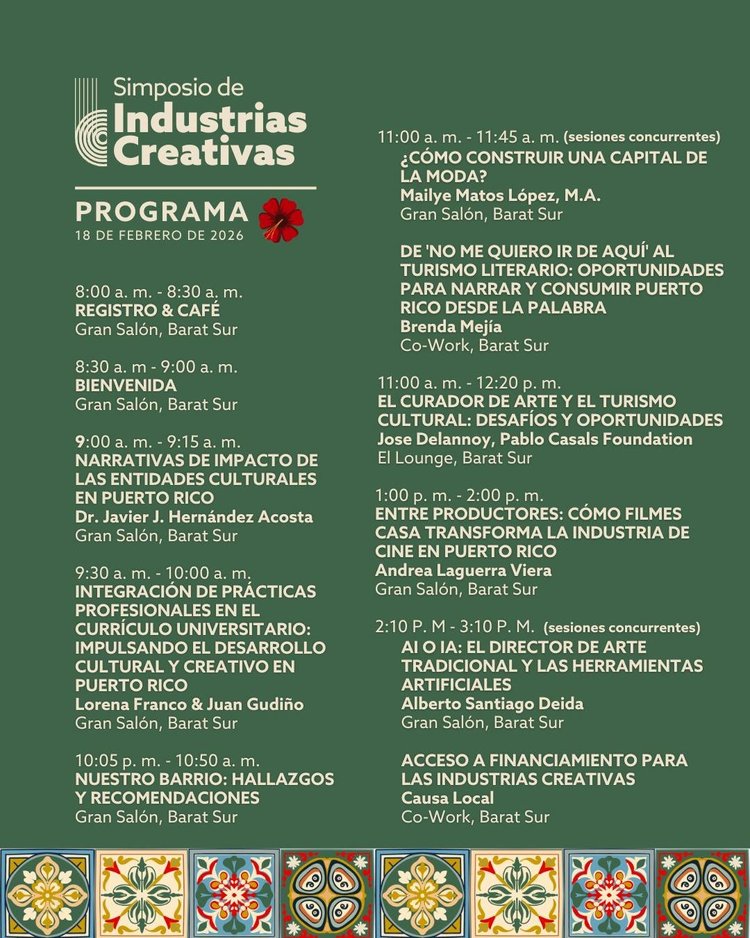
Creative Industries Symposium
|
|
In September 2017, while Hurricane María was tearing Puerto Rico apart, I was in Asheville, North Carolina, at a workshop called Crafted Production (Carolina Textile District + Industrial Commons). It was, essentially, an intensive retreat on small- to mid-scale textile manufacturing: that uncomfortable but powerful in-between space where you’re not making five pieces in your studio… but you’re also not producing 500 units a day. That middle ground which, in Puerto Rico, still feels more like a dream than infrastructure. The group was diverse: aspiring manufacturers, designers wanting to control their own production, growing brands. I arrived at a pivotal moment—I was just beginning to shape what would later become Retazo, the circular fashion platform I launched and eventually closed between 2017 and 2020. I also attended as a translator for the Cuban brand Clandestina, an experience that allowed me to observe the ecosystem from both the inside and the outside at once. During that week, we visited factories and textile mills—nothing “mega industrial,” but deeply strategic, because the focus was precisely on that intermediate terrain where real capacity is built. We talked about local ecosystems, practical circularity, public-private partnerships, and how a region like North Carolina—once a textile mecca—is attempting to rearticulate its productive muscle through community-based, collaborative models. I left Asheville with my heart both lit up and broken. I wanted to return to Puerto Rico and implement everything through Retazo—but the island was devastated. And as we know, not even the basics, like our power grid, ever truly returned to what they were.
|
|
I’ll be talking about all of that at the symposium in my presentation: “Cooperative Models and Scaled Manufacturing (Crafted Production): Financing and Production Solutions for Local Fashion in Puerto Rico.” I’ll share three case studies: North Carolina — the Carolina Textile District ecosystem and its intermediate-scale manufacturing model. Puerto Rico — Retazo, and the trainings I delivered for sewing cooperatives that are still holding up real possibilities for fair development on the island. Nest (Alabama & Mexico) — the pricing and costing structure trainings I facilitated for artisans in Gee’s Bend and makers in Oaxaca.
The symposium will also feature powerful presentations: my colleagues and friends Mailye Matos will speak on how fashion capital is built, and rika Medina will present on the many possible careers in the art world without being an artist. If you’d like to attend, you can register here. The event is free.
|
The Super Bowl: Benito wore Zara and his dancers too.
|
|
I watched the show and, at first glance, I loved the fashion (and I loved the show, too). I’m not going to weigh in on anything here except the FASHION. A part of me felt like it was right there—between the sugarcane fields, under the power lines, and with Toñita: the same Toñita who rescued more than one hangover (mine and several friends’) in Williamsburg with queso de papa and salchichón, circa 2012. But I watched it a second time and a third time, with a cooler head and a more objective lens… and I started noticing things that can’t be ignored about the fashion statements that were made. Because the internet won’t let Benito subject rest: what he wore to the Super Bowl, what “the house celebrities” wore, the dancers… and I’m going to summarize it in my favorite format: the good, the bad, and the ugly (fashion + sustainability), with the same question as always: sustainable for whom? Let’s start with the good. Yayi, Pleneros de la Cresta at the Super Bowl, dressed by a designer and dear colleague I deeply admire—bravo. Guayaberas made in Puerto Rico, with beautiful embroidery… that’s living culture, craftsmanship, and pride worn well. Eeee, fua! Jomas , a puerto rican designer, dressed several of the “house celebrities” and some of the dancers. I haven’t had the pleasure of meeting her in person, but what beautiful work and so well executed. You could see intention, you could see the hand, you could see the level. Luar, the Dominican-American designer with tremendous talent, dressed Lady Gaga in a suit whose pleating was done at Tom’s International Pleating, in New York—one of the few remaining workshops sustaining a craft that’s nearly extinct. The art of pleating is fascinating: technique, patience, and precision turned into movement. A double round of applause: that kind of representation matters… and that baby blue was divine. The pavas. Here my heart wants to believe the best: natural palm, artisans, a transparent supply chain. But being honest… I doubt it. I don’t have the data, so I’ll leave it as an open (and necessary) question. Ricky Martin. That’s it. This is not objective, and I have yet to find out who he wore. Let’s hope him and his team made good sensible choices.
Now the bad: Zara. They dressed Benito—and also part of the cast: dancers, band, even the orchestra. Vogue can tell the story better than I can: “It was the first time Zara has ever outfitted a performer on such a large scale; they also dressed his backup dancers, band, and orchestra.” Zara, the multinational emblem of the infrastructure that sustains fast fashion, surpassed only by the even more accelerated logic of ultra-fast fashion like Shein. Ugh. .The cringe I felt. The entire show—and here I quote my colleague and fashion and society analyst, Maylie Matos: “It gave you cringe because it’s made for the tourist gaze; it’s a PR stunt.” I fully agree. And that cringe, honestly, isn’t going away. Lady Gaga. It gave me cringe to see an openly Zionist artist singing and dancing salsa within an aesthetic that felt far too reminiscent of the “postcard/tourist” lens of Puerto Rico: Fiesta Island (1953). That visual language has not aged well, and today it feels even heavier with cliché.
And the ugly: The infrastructure that does not exist in Puerto Rico. I’ve seen many media posts saying that Bad Bunny’s team should have used local designers for all the costumes. And I wish it were that simple, but here’s the hard truth: in Puerto Rico today, there is no factory capable of taking on a commission the size of outfitting hundreds of dancers for the Super Bowl. There is no local infrastructure where, instead of ending up with Zara, that work could have been assumed by an island collective or a well-organized network of workshops. That capacity is not built—and it’s not built on talent alone. It’s built on systems: strong technical education, industrial patternmaking, production planning, costing, timelines, quality control, and operations management. What we have are military factories handling federal contracts. That’s why I insist so much with my students at Sagrado—especially those who want to stay in Puerto Rico—that they take the course I created: Design for Manufacturing. Because this isn’t about a “lack of creativity”; it’s about installed capacity. Designing for manufacturing is a different lens: thinking with the workshop in mind from the very first sketch, here or anywhere in the world. That said: Mexico, Colombia, and Brazil do have that capacity, and they also have designers and workshops operating at a high level. There was no need to default to a multinational. Sustainable for whom? Wearing a brand emblematic of our first colonizer, Spain, while attempting to represent (even visually) the injustices of our other colonizer, is an oxymoron that’s hard to overlook. And the narrative that “Zara is accessible”—or that wearing something “everyone can buy” is an act of solidarity—doesn’t withstand much scrutiny. At best, it’s incoherent. If Bad Bunny’s team still doesn’t have serious sustainability and supply chain advisory, we should talk. Because this is failing at the easy part: if the move was advertising for Zara, why lend yourself to that at the peak moment of your career, when you don’t need it? Especially when you’ve already had a multi-year collaboration with Adidas—meaning the “big brand partnership” box was already checked. So the only conclusion left is that sustainability, here, is economic—and limited.
|
Do you have a product in mind to develop sustainably? Let’s talk!
|
Our consulting services are designed to support individuals and companies looking to strengthen their operations—from the products they create and sell to logistics, supply chain management, and infrastructure. We bring over 20 years of combined experience in the creative industries. In Auralis’ case, that includes 7 years inside a factory, learning manufacturing from the most analog techniques to the most advanced technologies. In Ruby’s case, it represents more than 15 years of international advisory work supporting creative industries at every stage. If you need guidance, schedule a call here. |
|

|
|
|
PS: All the bulletins are here.
|
|
|
|